Setting the Stage: Building Awareness and Shared Responsibility
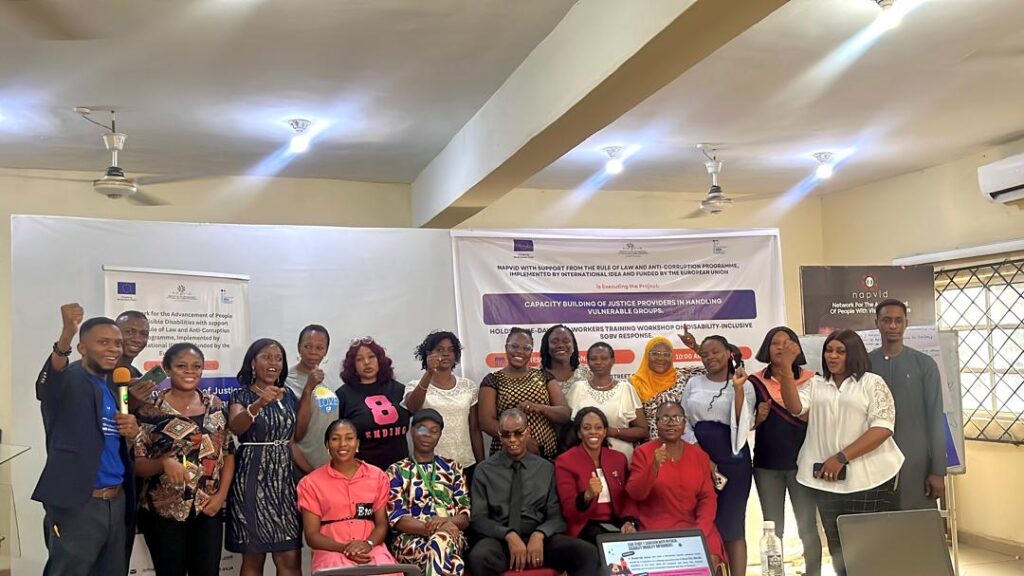
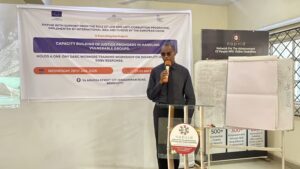
On 28 January 2026, the NAPVID Secretariat Hall became a center of learning and reflection as frontline responders, justice actors, and service providers gathered for a one-day training on disability-inclusive responses to sexual and gender-based violence (SGBV). The workshop was organized by the Network for the Advancement of People with Visible Disabilities (NAPVID) under its Capacity Building of Justice Providers in Handling Vulnerable Groups project, with support from the Rule of Law and Anti-Corruption Programme II, implemented by International IDEA and funded by the European Union.
Facilitated by Melody Omosah Esq. and anchored by the Project Officer, Isaac Noble, the programme drew participants from Vivian Sexual Assault Referral Centre (Vivian SARC), Edo State Ministry of Women Affairs and Social Development, and Office of the First Lady of Edo State. Participants expressed strong interest in understanding different forms of disability, developing practical skills, and learning how institutional barriers affect survivors’ access to justice. These early discussions set the tone for a rights-based and survivor-centered engagement.
A major focus of the training was reshaping perceptions of disability. Participants explored the charity, medical, social, and human rights models, reflecting on how outdated views often limit opportunities for persons with disabilities. The sessions emphasized that disability is not defined by impairment alone, but by the barriers created within society. By adopting the social and human rights models, service providers were encouraged to recognize survivors first as individuals with dignity, autonomy, and legal rights.
Creating Accessible, Responsive, and Survivor-Centered Services
The workshop placed strong emphasis on the importance of reasonable accommodation in SARC service delivery. Participants learned that accessibility must be deliberately built into facilities and procedures. Features such as ramps, handrails, spacious toilets, clear signage, and safe waiting areas were highlighted as essential for creating welcoming environments. Attention was also drawn to technical details, including the need for non-slippery ramps and adequate space for wheelchair users.
Communication accessibility was equally emphasized. Survivors with hearing, visual, intellectual, or speech impairments often face difficulties when reporting abuse. To address this, the training stressed the provision of sign language interpreters, alternative communication tools, and easy-to-read materials. Participants were reminded to always address survivors directly, respect their preferred communication methods, and avoid assumptions about credibility or capacity.
In addition, procedural accommodations were discussed as vital tools for preventing re-traumatization. Extended interview time, flexible scheduling, the presence of support persons with consent, and trauma-informed approaches were presented as ways to help survivors feel safe and respected. The medical, forensic, and psychosocial dimensions of care were also explored, with emphasis on privacy, dignity, supported decision-making, and minimizing repeated examinations.
Together, these measures were presented as essential elements of a responsive system that prioritizes survivor wellbeing while strengthening the integrity of investigations and prosecutions.
Strengthening Access to Justice, Safeguarding, and Accountability
Access to justice was identified as a key outcome of disability-inclusive SGBV response. Despite existing legal protections, survivors with disabilities often face communication, procedural, and attitudinal barriers that discourage reporting and weaken prosecutions. The training addressed strategies such as accessible statement-taking, interpreter support, court accompaniment, and protection from intimidation to ensure that survivors can fully participate in justice processes.
Safeguarding and ethical practice formed another critical pillar of the workshop. Participants discussed the need to address power imbalances, dependency relationships, and institutional risks within SARC and justice settings. Emphasis was placed on confidentiality, data protection, and zero tolerance for discrimination, abuse, or exploitation by staff. Survivors must be confident that SARC facilities are safe spaces where their dignity and rights are respected at all times.
The workshop also highlighted the importance of awareness creation, documentation, and inclusive data collection. Participants explored strategies for community sensitization, partnerships with organizations of persons with disabilities, and outreach to schools. Inclusive reporting templates and disaggregated data were identified as tools for understanding patterns of abuse and strengthening evidence-based advocacy.
In his closing remarks, Melody Omosah Esq. encouraged SARC workers, law enforcement agencies, and other justice actors to apply the lessons learned in their daily work. She emphasized that when services are accessible, respectful, and disability-friendly, survivors are more likely to seek help and pursue justice.
The training reaffirmed that building inclusive justice systems requires sustained commitment, collaboration, and accountability. Through this initiative, NAPVID and its partners continue to promote survivor-centered, rights-based responses that ensure no one is left behind.
Training Outcomes and Key Achievements
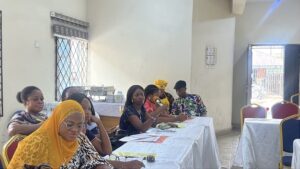
The one-day capacity-building workshop on disability-inclusive SGBV response produced clear and practical outcomes that strengthened the capacity of SARC workers and justice actors. Through interactive sessions and guided discussions, participants gained improved understanding of disability from social and human rights perspectives, enabling them to move beyond stereotypes and adopt more respectful, survivor-centered approaches in their work.
Participants were equipped with practical skills on providing reasonable accommodation, including improving physical accessibility, enhancing communication support, and applying flexible procedures during survivor engagement. This has increased their ability to respond effectively to the diverse needs of survivors with disabilities without causing further harm or exclusion.
The training also strengthened participants’ competence in trauma-informed medical, forensic, and psychosocial support. Service providers developed better awareness of how to adapt examinations, interviews, and counselling services to protect survivors’ dignity, privacy, and emotional wellbeing, while maintaining the integrity of investigations and prosecutions.
In addition, the workshop improved participants’ capacity to facilitate access to justice for survivors with disabilities. Attendees gained practical knowledge on accessible statement-taking, use of interpreters and intermediaries, court support mechanisms, and institutional collaboration, all of which are essential for reducing barriers within the justice system.
Another key outcome was the reinforcement of safeguarding and ethical standards within SARC operations. Participants committed to upholding zero tolerance for discrimination, abuse, and exploitation, strengthening confidentiality practices, and establishing clear reporting channels for misconduct.
Finally, the training enhanced institutional awareness of the importance of documentation, data collection, and community outreach. Participants were better positioned to implement inclusive reporting templates, collect disaggregated data, and engage in targeted awareness campaigns in partnership with organizations of persons with disabilities.
Recent Posts
-
 Building Inclusive Justice: Strengthening Disability-Inclusive Responses to Sexual and Gender-Based Violence
 -
 NAPVID LEADS STRATEGIC PLANNING FOR THE EDO STATE COMMISSION FOR PERSONS WITH DISABILITIES.
 -
 NAPVID Champions Access to Justice through the Validation of the Sim plified Edo State Disability Law.
 -
 GET YOUR CHILD TO SCHOOL: DISABILITY NOT A BARRIER.
 -
EOI – Consultancy for the Simplification of the Edo State Disability Rights Law